
LH2 Shipping Secures MNOK 237,6 to Cut CO₂ Emissions across Maritime Segments based on Proven Technology
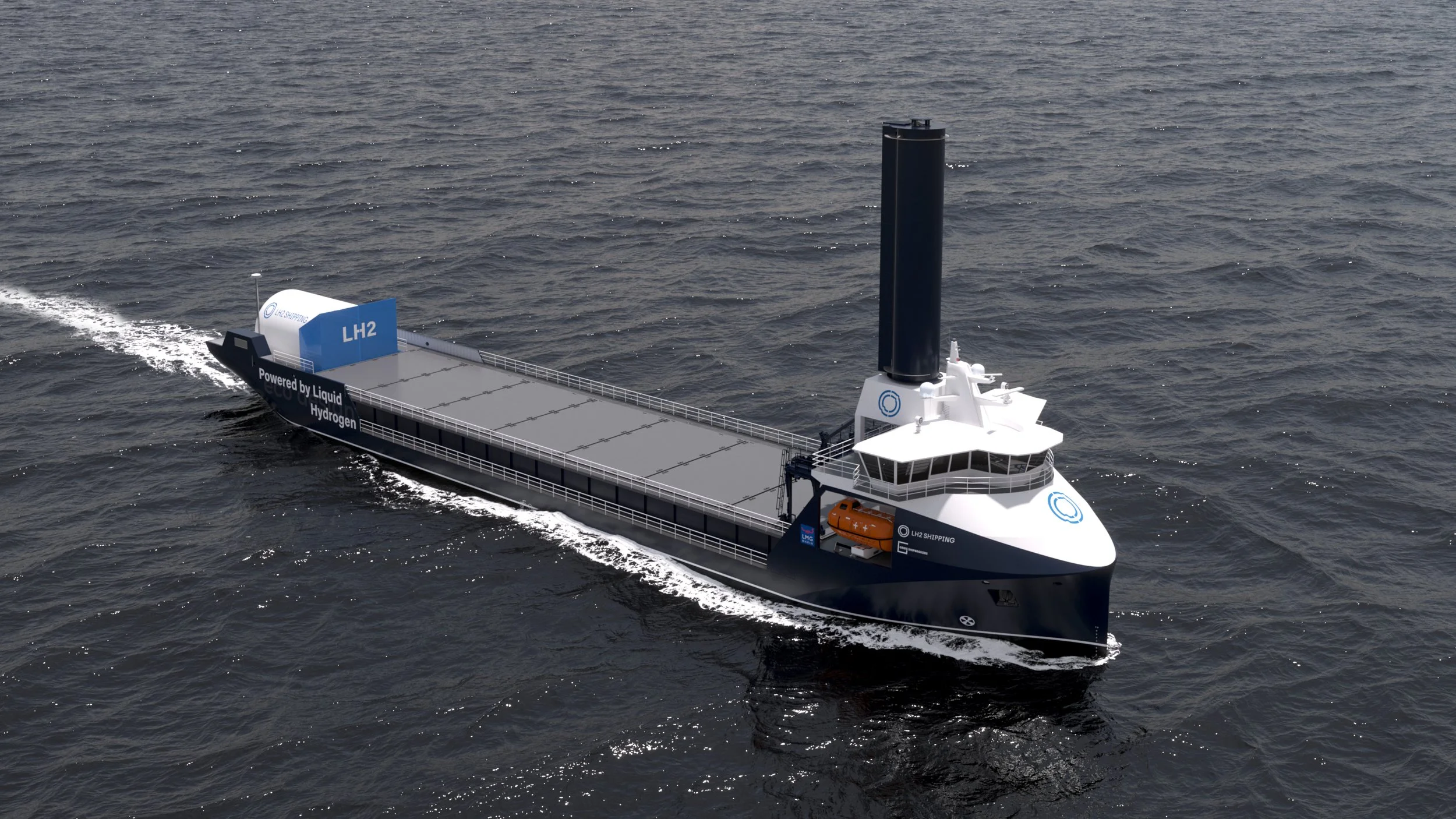
Hydrobulk by LH2 Shipping AS, powered by liquid hydrogen (LH₂), eliminating CO₂ emissions from maritime operations.
Press Release by LH2 Shipping
Backed by ENOVA: LH2 Shipping Secures MNOK 237,6 to Cut CO₂ Emissions across Maritime Segments based on Proven Technology
LH2 Shipping is taking a leading role as the world’s first two bulk carriers powered by liquid hydrogen (LH₂), eliminating CO₂ emissions at sea, have received Enova support for their construction. This milestone award marks a shift in focus from ferries at short fjord crossings, to applying LH₂ ship technology for a wide range of seagoing vessel types — from container and general cargo vessels to offshore supply and cruise, which addresses large, impactful segments of the maritime industry, where emissions reductions can be achieved at scale.
LH₂ operation at sea has been demonstrated for two years to be a safe and robust solution onboard Norled’s pilot project M/F Hydra, where LH2 Shipping personnel worked as project managers. The new cargo ship project will scale up this technology to short sea shipping operations, and will, in addition to an efficient operation offering long range at sea, eliminate CO₂ emissions, which will both meet future CO₂ emission reduction requirements within shipping and provide added value for cargo owners in relation to future requirements.
“We are very pleased with this award and would like to thank Enova for the support so far from the pre-project phase and now into the construction phase. This enables us to accelerate the development of fully emission-free vessels, using a combination of fuel cells and batteries in hybrid systems, whilst ensuring reliable, future-proof operations. At the same time, we ensure ship operators and cargo owners staying ahead of increasingly strict emissions regulations — by offering safe and emission-free solutions at sea”
With foreseen charges for CO₂ emissions, the EU ETS, Fuel EU Maritime and upcoming IMO scheme, the cost gap between fossil fuels and alternative fuels is minimised. The business case of zero-emission vessels, and their operations, is expected to improve significantly, especially after 2030 when the CO₂ emission fees are further increased.
Development of Norwegian hydrogen infrastructure for maritime consumers
Only the availability of maritime LH₂ fuel infrastructure along the coast will enable shipowners to move forward with investment decisions for LH₂ powered vessels.
«In LH2 Shipping, we look forward to build ships promoting the realisation of efficient and affordable LH₂ supply chain infrastructure along the coast”, says Oestvik.
Stepping up - From inland ferries to shortsea shipping
«LH2 Shipping has been preparing ship concepts for years and we are now stepping up our activities. We are currently contributing to the development of a wide range of zero-emission ship concepts, which both creates a market for LH₂ production as well as proving industry insight into zero emission sea transport. These projects are breaking new ground and accelerating the transition toward carbon-free maritime transport — without compromising on operational performance or safety and at the same time offering range and duration at sea.”, states Oestvik.
LH2 Shipping is now scaling up and expanding into new ship segments where fuel cells and batteries work together in hybrid systems to provide reliable and safe solutions at sea.
“We see that fuel cells and batteries are working very well together in hybrid systems where different routes and ship types provides different system combinations. Some routes can be operated 100% on batteries whereas fuel cells and LH₂ are added where range and charging issues are dominant.”, Oestvik says.
Taking leadership, advancing proven Technology
“Investment in zero-emission ship development demonstrates a clear commitment to climate leadership and sets a global example for the green transition at sea. We are deeply grateful to ENOVA and the support mechanisms that make real, large sale decarbonisation of shipping possible. This aligns closely with our core ambition: to make zero-emission sea transport a practical reality”, says Lars Jacob Engelsen, Chair of the Board of the company.
The company's commitment to enabling emission-free shipping is also linked to the vision of working actively to help solve the dominant challenges in the global maritime industry.
“Enova support for projects aimed at developing zero-emission vessels is paving the way for a cleaner maritime future and positioning
-
LH2 Shipping AS is a leading innovator in zero-emission shipping, dedicated to enabling the transition to sustainable sea transport. Headquartered in Bergen, Norway, the company develops and delivers liquid hydrogen (LH₂)-powered solutions for a wide range of vessel types — from general cargo and bulk carriers to offshore supply vessels and cruise. Founded in 2023, and with extensive experience from maritime industries, serving as Project Lead for developing, building, commissioning and set to sail the world's first LH₂ powered vessel, the ferry M/F Hydra (Norled AS). LH2 Shipping is committed to pioneering practical, scalable, and proven green technologies that enable cargo- and shipowners meet tomorrow’s emission requirements today.
-
LH2 Shipping is Project Owner and Project Lead for the HYDROBULK Project.
The HYDROBULK project will develop, build and commission two 5000 dwt gearless bulk carriers for short sea shipping between Norway/Sweden and the Continent. The ships will use LH₂ (liquid hydrogen) as the main fuel source, where fuel cells and batteries work together in hybrid systems, and will operate 100% emission-free all year round. The ships will have a length of approx. 96m and a width of approx. 16m and have approx. 11 tonnes of LH₂ storage capacity and 2 MW power output on PEM fuel cells on board. A 1 MWt battery pack will be installed to support the fuel cells. The ships will be arranged to use shore power where this is available for loading and unloading operations. A standby diesel generator package is also installed, where the ships can sail on diesel/biodiesel if the LH2 supply fails or is not in place in time when the ships are delivered from the shipyard.
The ships are designed with an efficient hull and propulsion solution that will have a minimum of 30% lower energy requirements compared to current ships in the same segment. Wind sails will be installed that will further reduce the energy requirements on board by approx. 10% annually. Other energy-saving technologies are included in the design with regard to propulsion, structural weight and an efficient energy management system on board. The ship designer is LMG Marin.
LH₂ operation has been demonstrated to be a safe and robust operation for over two years with the pilot project M/F Hydra. The cargo ships scale this technology to short sea shipping operations, and in addition to efficient operation, will eliminate CO₂ emissions in shipping transport, which both meets future CO₂ emission requirements within shipping and provides added value for cargo owners in relation to the requirements that will come for their Scope 3 reporting. With expected increases in CO₂ emissions taxes, the EU ETS, together with the FuelEU Maritime scheme, is expected to minimise the cost gap between traditional and alternative fuels. The value of zero-emission vessels, and their operation, is expected to increase significantly, especially after 2030.
-
Ivan Oestvik
CEO & Owner
LH2 Shipping AS
ivan@lh2shipping.no
+47 9953 0720
Maria Schütz Fløisand
Chief Communications Officer
LH2 Shipping AS
maria@lh2shipping.no
+47 9203 0905